Culture
Maithili Art and Culture: Janakpur's Living Tradition
Janakpur in Nepal's Madhesh is the birthplace of Maithili culture, home to intricate Mithila paintings and the most elaborate Vivah Panchami celebrations in the world.
The Kingdom of Mithila
Janakpur, in Nepal's Madhesh Province near the Indian border, is one of South Asia's oldest cultural centers. In Hindu tradition, it is the birthplace of Sita and the kingdom of King Janak, her father. The mythological geography makes Janakpur a site of pilgrimage for millions of Hindus, and the city maintains a cultural identity rooted in this ancient heritage. The Maithili people, who speak Maithili, one of Nepal's recognized languages, inhabit a region that straddles the Nepal-India border and maintain a distinct cultural world with its own literature, music, and visual art.
Mithila Painting: Women's Art on Walls and Paper
Mithila painting is perhaps the most internationally recognized art form from Nepal's Terai. Traditionally, women painted intricate geometric and figurative designs on the mud walls of their homes for ceremonial occasions, especially weddings. The paintings depict scenes from Hindu epics, surrounded by borders of peacocks, fish, bamboo, and lotus flowers. Colors were made from natural pigments: indigo, turmeric, and lampblack. In the 1960s, following a devastating drought, a development organization introduced paper as a medium, allowing these paintings to be sold as art. The Janakpur Women's Development Centre has been central to sustaining this tradition as a commercial and cultural force, with hundreds of women artists working cooperatively.
Vivah Panchami: The Wedding of Ram and Sita
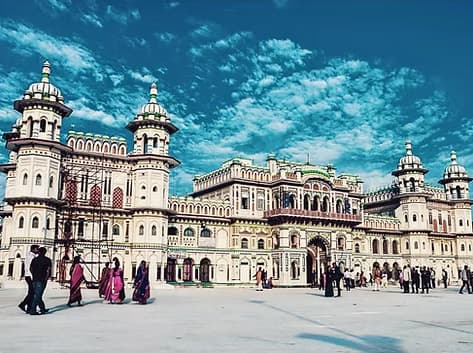
Every year in November or December, on the fifth day of the bright fortnight of Marg, Janakpur celebrates Vivah Panchami, the reenactment of the legendary wedding of Ram and Sita. A procession carrying an image of Ram travels from Ayodhya in India to Janakpur, where the wedding ceremony is performed at Janaki Mandir, one of the largest Hindu temples in Nepal, built in ornate Mughal-Rajput style. The streets fill with hundreds of thousands of pilgrims for multiple days. The ceremony includes theatrical performances of Ramayan scenes, music, and a massive communal feast.
Janaki Mandir
Janaki Mandir is the architectural landmark of Janakpur, a grand white marble temple completed in 1911. Its 60 rooms, marble floors, and ornamental archways make it unlike any other temple in Nepal. It is dedicated to Sita and receives thousands of devotees daily. The atmosphere is warmly devotional rather than touristy, and visitors who sit quietly in the main courtyard experience the genuine spiritual life of the Maithili community.
Planning this trip? 🎒
Don't stress about transport or guides. Sajilo offers verified cabs, luxury tourist buses, and expert guides across Nepal.
FAQ
Q: How do I get to Janakpur from Kathmandu?
Janakpur is connected to Kathmandu by daily flights (35 minutes) and by a long bus journey (8-10 hours). A narrow-gauge railway, the only one in Nepal, runs from Janakpur to Jaynagar at the Indian border, though its schedule is limited.
Q: Where can I buy authentic Mithila paintings?
The Janakpur Women's Development Centre is the most reliable source for authentic paintings at fair prices, with proceeds going directly to the women artists. Avoid mass-produced copies sold in Kathmandu tourist shops.
Q: Is Maithili language related to Hindi?
Maithili is an Indo-Aryan language and is related to Hindi and Nepali, but it is a distinct language with its own script (Mithilakshar) and literary tradition dating to the 14th century. It is not mutually intelligible with Hindi.